The Criticality of Hyper-Localization for IOPs and PHPs.
In my experience, many Intensive Outpatient Programs (IOPs) and Partial Hospitalization Programs (PHPs) struggle to maintain a consistent flow of leads and admissions, not because their clinical care is lacking, but because they aren't visible where it matters most: in their immediate geographic area. The truth is, you’re program is not very different than the local Chinese Restaurant in that you have to contain your marketing and build your search engine visibility within a reasonable driving distance of your center. On balance, how far do your clients currently travel for treatment? 20, 25, 30 miles? Whatever that is, that’s the pond you need to fish in. And that’s where hyper-local optimization becomes essential.
Google On a Grid
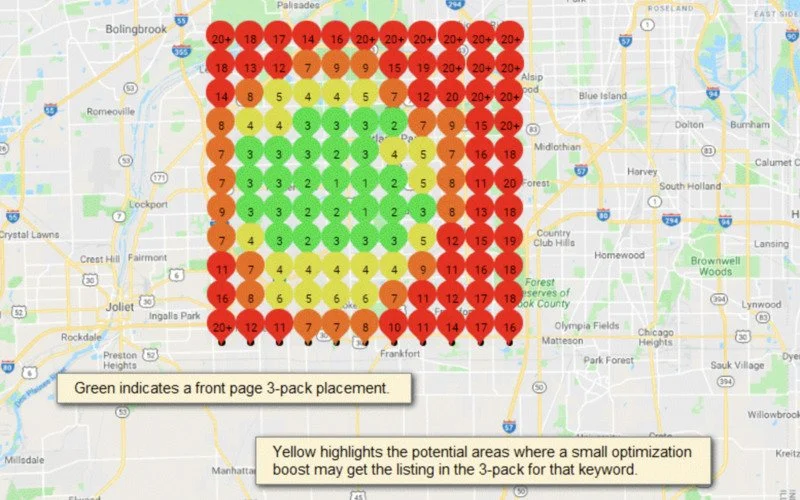
Google doesn’t just look at your office location and match you to a user searching nearby. Instead, it builds a grid—an invisible, location-based overlay across a map. Each point in that grid represents a hypothetical search location. Google runs simulated searches from those points (e.g., “IOP near me”) to assess how well you rank at each location on the grid.
For example, let’s say your IOP center is in Pasadena, CA. A 10-mile grid might include simulated searches from Altadena, Glendale, Alhambra, and other nearby neighborhoods. Google analyzes:
Your proximity to each search point
Your relevance (are you a mental health or SUD treatment provider?)
Your prominence (Google reviews, backlinks, mentions)
Website content & on-site SEO
NAP (Name Address Phone) consistency and Google Business Profile optimization
Based on those factors, your rankings and visibility can vary dramatically from your actual location to a point just 10 or 20 miles in any direction. It is critical that you localize for all of the surrounding cities or towns in your service area. In the illustration below, a treatment program ranks #1 for selected search terms in its actual location whereas 10 miles to the north/north west it ranks 8th for the same terms.
What Is Hyper-Local Optimization?
Hyper-local optimization is essentially fine-tuning your marketing strategies to target prospective clients in a narrowly defined geographic area—often within a 10 to 25-mile radius around your IOP or PHP (private practice therapists take note). This goes beyond basic local SEO; it includes community engagement, partnerships, content, and listings that are tailored to the people in a specific ZIP code, city, or town. For IOPs and PHPs, which rely on a steady flow of clients including and outside of their immediate location, this level of specificity is an imperative.
Why It Matters for Mental Health and SUD PHP/IOP Programs
Unlike residential or inpatient care, IOPs and PHPs serve people who are integrated into their communities. Their access to care often depends on proximity, transportation, and local referral patterns. For this reason, ranking #1 in Google searches for “IOP for depression” means little if it’s happening in a city 30 miles away. You need to be visible to people searching for help near their town. And that’s you.
The Building Blocks of Hyper-Local Optimization
Local SEO & Directory Listings
Ensure your Google Business Profile is fully optimized with accurate hours, services, photos, and regular updates in the form of articles, news, announcement, and events. It need to be a living, breathing entity in Google’s estimation.
Use consistent NAP (Name, Address, Phone Number) across all directories (Yelp, GBP, Psychology Today, Healthgrades, your website, etc.).
Seek reviews from real clients and families, encourage them to use language that includes phrases like “IOP in [City]” or “PHP near me.”
Localized Content Marketing
Create blog posts and location pages that incorporate specific city or neighborhood names.
Write about local mental health challenges, events, and laws. For example, “What California’s New Mental Health Reform Means for Teens in Pasadena.”
Use testimonials or case studies that mention the local community, which helps build trust.
Community-Based Outreach
Host or sponsor mental health awareness events in your community.
Engage in speaking opportunities at town halls, local colleges, or nonprofits.
Geo-Targeted Advertising (if you can afford to augment your optimization work with paid outreach)
Test the use pay-per-click (PPC) and social media ads to target users in specific zip codes.
Test geofenced ads around hospitals, emergency rooms, or clinics where people often begin their search for treatment options.
Mobile and Map Optimization
Ensure your site is mobile friendly—most local searches happen on smartphones.
Submit your location to Apple Maps, Waze, and other GPS systems that people use to find nearby healthcare services.
Many IOPs and PHPs make the mistake of relying on national directories or broad marketing tactics. While these may bring some awareness, they don’t translate into leads that drive your practice. Hyper-local optimization gives your program a competitive edge by putting your services directly in front of the people most likely to need and use them—people in your service area. — PD